
The Remaster

A year ago I woke up and looked around my home with that particular mix of satisfaction and unease. Satisfaction, because I was surrounded by things that reflected who I was. Unease, because there were no films. Maybe an old DVD box of The Wire but that was about it.
Maybe it was because I first educated myself through torrents. Twelve years old, alone in my room, burning through the IMDb Top 250 like it was homework nobody had assigned me. I needed to know what all the fuss was about and I fell in love with the medium straight away. I can still remember watching 2001: A Space Odyssey on my bed at 1 a.m. on a crappy laptop with my ex sleeping peacefully next to me.
Now, a year and 200 films later, I have given them a special place in a beautiful cabinet with ribbed glass doors. The films give me a strange peace of mind, because each one carries the story of a director who once lived, struggled, obsessed and put their whole life into something that now exists on a tiny disc (or on some server) in 2026.
For me, preservation is everything. I bought my first Blu-ray when I was around sixteen. Se7en, in that beautiful blue case. I still remember thinking my TV was broken, because I had never seen that much grain in my life. Only later did I understand that Blu-ray held enough data to preserve the grain that compression usually swallowed. That grain is the soul of the film. Organic proof that light actually touched celluloid.
And yet, I understand the opposite impulse too.
Why James Cameron had the grain stripped from the 4K releases of his older work. Why Fincher puts fake anamorphic flares on a film shot with spherical lenses (because it looks cool!). And why George Lucas went back in the nineties and filled the Star Wars universe with extra creatures and CGI crowds. I can imagine the agony of watching your own film and seeing the plywood of the sets. The edges of a world that was supposed to be infinite. Not alien enough. Never alien enough.
I understand the desire to make something feel timeless. Perfect. Like 2001.
Is that a betrayal of your own memory of the film, or the ultimate expression of how a filmmaker wants their work to be remembered?
It is a fine line, and there is no clean answer.
And of course, once you start thinking like that about the films you love, it is not long before you think the same about your own work. Because one day, they will also be old objects. Files on a drive. A disc in a box.
I have made four short films now. My first was Leeuw Panter Wolvin, in 2019. €7,800, a lot of time, and long letters written to good actors. We shot it in four days inside the wonderfully unhinged house of Dutch celebrity Johan Vlemmix (he has since sold it). I graded it myself in 2019. Then again in 2020. Then again in 2024. Three different versions, all born from the same dissatisfaction with the colour. Part of it came from my own technical limitations. Part of it came from the conditions under which the film was originally shot and lit.
Every year I found myself opening the same old hard drive, pulling up the same footage, trying once more to get it right. In 2024, out of sheer frustration, I taught myself to grade in DaVinci Resolve. It still was not enough. Eventually, I did what I probably should have done years earlier. I convinced Wietse to take it on.
Wietse van Bezooijen has graded all my other short films. He called it a remaster. I call it the definitive version.
It is a strange thing, reopening old work and presenting it anew. Is it a falsification of history? Does something get lost when a maker goes back and fills in what they always imagined was there? For me, a film is never really finished. It is an imperfect thing by nature, built from the limitations of everyone involved. Every department. Every accident. Every compromised decision made under pressure. And maybe that imperfection is where the truth lives. Something a computer cannot replicate, because it comes from human failure. There is something beautiful in all those small organic mistakes.
So starting today, I am burying that hard drive and presenting the definitive version of Leeuw Panter Wolvin.
A new aspect ratio. Open matte. New colour. A few audio touches here and there. Not because I had to. Not because I could. But because I can finally give the film a place to rest.
And maybe, one day, when I am old, some kid in Amsterdam will have his own cabinet with ribbed glass doors. He puts on his favourite film late at night, alone in his room. Goes to the extras. A handful of short films. He clicks the first one. Leeuw Panter Wolvin. And wonders if something is wrong with his TV. So much grain in the image.
Only later does he find out, nothing was wrong with his TV. It was always meant to look that way.
Perfect. Like 2001.
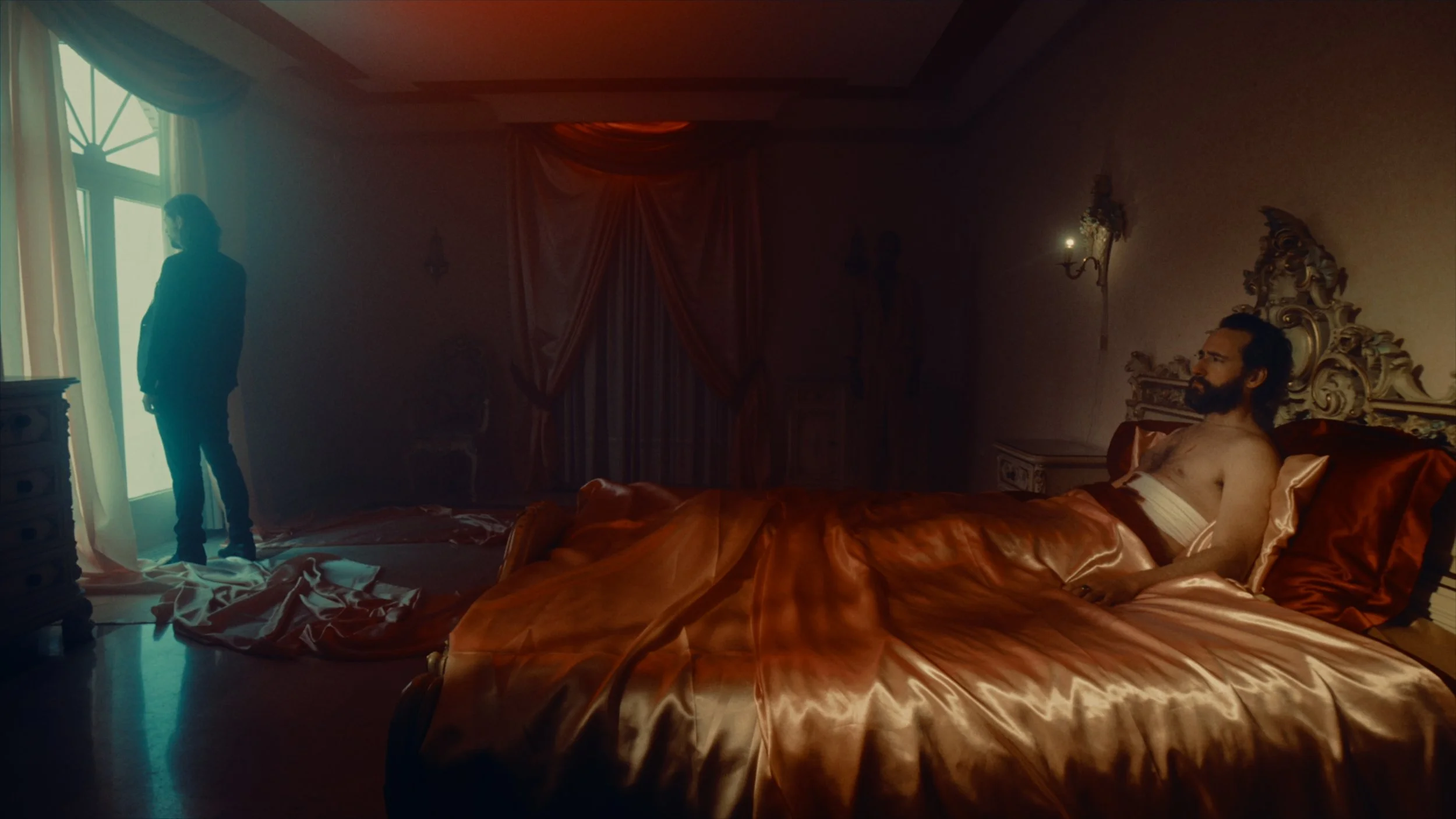
Still from Leeuw Panter Wolvin, 2026 version